There’s one question that looms large for marketers building backlinks for their website. How many backlinks are enough for a website to rank well and sustain?
There is no magic number of backlinks that guarantees a Google ranking. The number of backlinks for website ranking depends on the keyword, the pages already ranking, your page’s authority, the quality of competing link profiles, and how closely those links match your topic and intent.
So instead of thinking whether you need 50 backlinks or 500, think about how many relevant referring domains your page needs to become competitive with the pages already ranking. That is the number worth calculating.
Google’s ranking systems are designed to work at the page level, using a variety of signals and systems to rank individual pages. Google also uses site-wide signals, but explicitly notes that strong site-wide signals do not mean every page on a website will rank highly. Its ranking systems also include link analysis systems such as PageRank.
Key Takeaways
We know you already have questions reading the first few lines. So do not worry! Read further to have your doubts solved.
|
Question |
Answer |
|
How many backlinks do I need? |
Enough high-quality links to become competitive with comparable ranking pages |
|
Should I count backlinks or referring domains? |
Track both, but use referring domains for competitive benchmarking |
|
Are more links always better? |
No. Relevance, quality, context and source diversity matter when it comes to building good backlinks for SEO |
|
Can a page rank with few backlinks? |
Yes |
|
What should I benchmark? |
The top-ranking pages for your exact target query |
|
Should I buy a fixed number every month? |
No. Build against a measured competitive gap |
Why There Is No Universal Backlink Number to Achieve Website Ranking
Search results are not a level playing field. A new SaaS page targeting a low-competition query may compete successfully with a small number of relevant links. A finance, healthcare, or legal query may be dominated by established domains with years of authority.
Recent Ahrefs research shows why a universal backlink target can be misleading. In an analysis of 1 million high-volume keywords, Ahrefs found that referring domains had a 0.255 correlation with Google rankings, while total backlinks had a 0.248 correlation.
The relationship was stronger for higher-volume queries, local searches and informational content, suggesting that the competitive value of links varies significantly by query type.
Correlation does not equal causation. Ahrefs’ large-scale studies have repeatedly found relationships between referring domains and organic performance, while also warning that link quantity alone does not explain rankings.
So a statement such as “you need 100 backlinks to rank” is SEO arithmetic without context.
Backlinks vs. Referring Domains: Which Number Matters More?
Suppose your competitors look like this:
|
Site |
Backlinks |
Referring domains |
|
Competitor A |
900 |
18 |
|
Competitor B |
240 |
61 |
|
Competitor C |
175 |
49 |
|
Your page |
82 |
14 |
Competitor A has the most backlinks, but those links are concentrated across relatively few domains. That is why your competitive backlink analysis should separate:
- Backlinks: the total number of links pointing to a page or domain.
- Referring domains: the unique websites sending those links.
Semrush’s Backlink Gap tool lets you compare backlink profiles and identify referring domains that link to your competitors but not to your site, turning those gaps into potential link-building opportunities. Hence, don’t chase a competitor’s total backlink count. Find the relevant referring-domain gap.
What Is Backlink Analysis?
Backlink analysis is the process of evaluating which websites link to your pages, which pages receive those links, what those links look like, how your profile compares with competitors, and where your strongest opportunities and risks sit.
A useful backlink analysis answers five important questions before you get started:
- Which of my pages attract links?
- Which important pages have weak external authority?
- Which relevant websites link to my competitors?
- What content earns links in my industry?
- Which links have been gained, lost, or changed?
Tools such as Google Search Console, Ahrefs, Semrush and Majestic can be used to inspect backlink profiles, although their databases will not be identical because each tool discovers and indexes links differently. Semrush, for example, provides referring-domain, anchor, link-status and competitor-gap data.
The 5-Step Backlink Gap Formula
This is the framework to use instead of a generic backlink calculator.
Step 1: Choose one target query
Start with the exact keyword you want a page to rank for. Don’t benchmark your entire domain against another domain. Benchmark your target page against the pages ranking for that query.
Step 2: Collect the top 10 ranking pages
For each page, record:
- Referring domains
- Total backlinks
- Page-level authority
- Relevant referring domains
- Link quality
- Content format
- Freshness
- Search intent match
Step 3: Remove outliers
Imagine the referring-domain counts are:
12 → 19 → 24 → 29 → 34 → 38 → 44 → 51 → 230 → 1,100
An average would make your target almost useless. Instead, identify the median and comparable competitor cluster. Established publishers can distort the benchmark.
Step 4: Calculate the gap
Take this as a mathematical formula:
Competitive referring-domain benchmark − Your referring domains = Estimated link gap
Example:
Comparable-page benchmark: 44
Your page: 16
Estimated gap: 28 referring domains
But stop there. Twenty-eight random links do not necessarily equal the authority of those 28 competitor domains.
Step 5: Apply a quality and relevance filter
Prioritise domains based on:
Relevance + editorial quality + authority + context + audience
Then monitoring backlinks becomes part of the process: track new and lost referring domains, changes in important links, and whether your page’s competitive gap is actually narrowing.
A more streamlined approach to this formula is as follows:
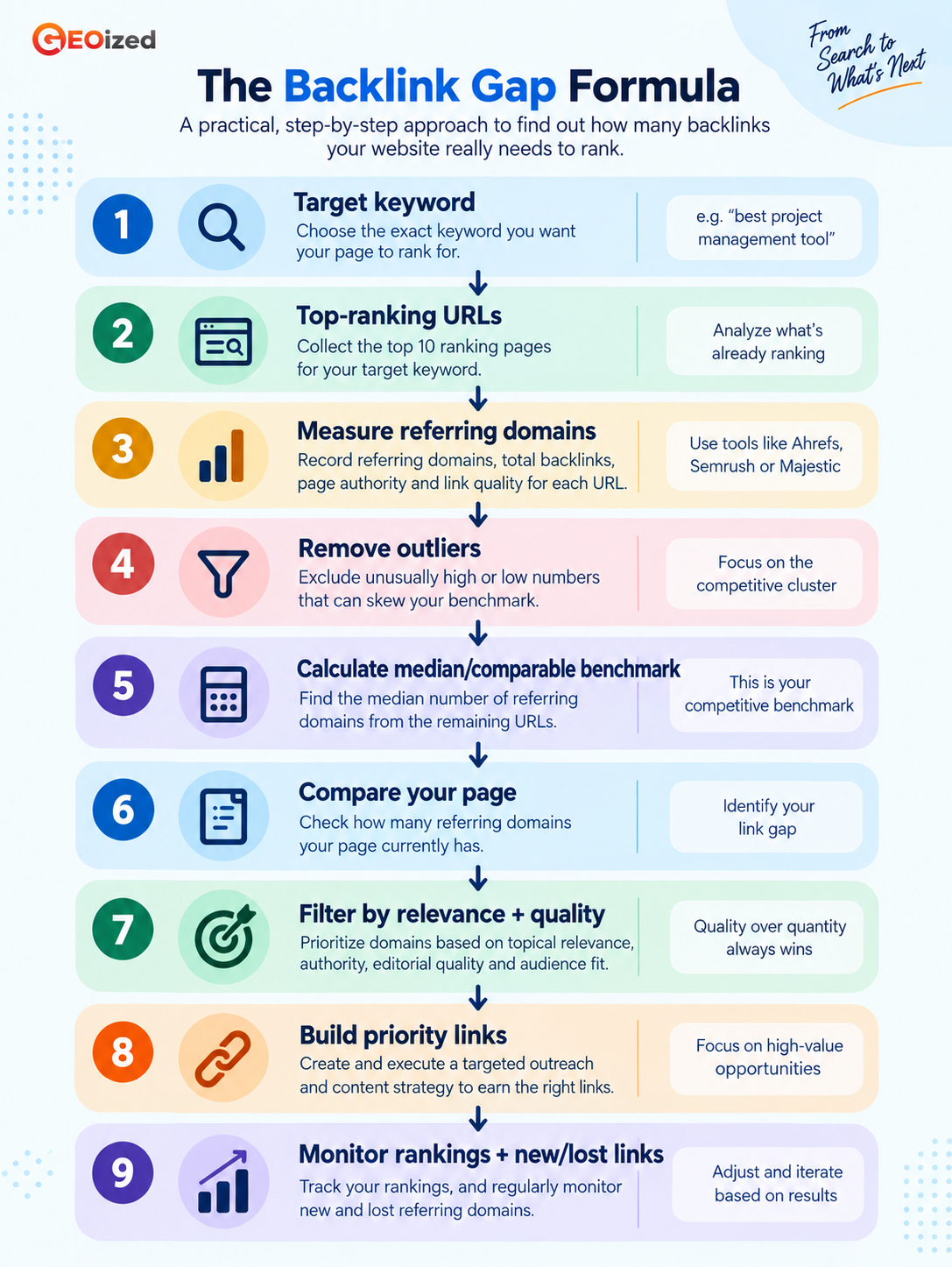
Hurry! Get a Free Backlink
What the Backlink Gap Looks: Real World Example
The formula becomes easier to understand when you look at established brands in the SEO, content and AI-search ecosystem. Let’s consider Semrush, Ubersuggest, Backlinko, Jasper and Ahrefs. Their backlink profiles differ substantially, which makes them useful for demonstration. Let’s take a look at their publicly available domain-level backlink data:
|
Brand |
Domain |
Referring domains / linking websites |
Backlinks |
|
Semrush |
semrush.com |
21M |
|
|
Ubersuggest |
ubersuggest.com |
16.5K |
|
|
Backlinko |
backlinko.com |
3.28M |
|
|
Jasper |
jasper.ai |
596.68K |
|
|
Ahrefs |
ahrefs.com |
7.28M |
If you simply averaged the figures above, the median turns out to be 75.29K referring domains. Would that mean every SEO or GEO company needs roughly 75,000 referring domains to compete?
If you want to be successful, numbers are important. The numbers represent the accumulated authority of entire websites and are built over many years. Those links can point to thousands of different pages, including homepages, product pages, research, tools, guides, reports, news coverage and blog content.
The lesson isn’t that you need a huge number of backlinks; it’s that authority accumulates over time and across many pages. And it should not compromise quality. To compete with bigger names in the industry, one should not fall for spam links. Every backlink must be relevant and yield higher value to the consumers.
How to Apply the Formula For Your Brand?
Imagine you are building a new GEO-focused page and want to compete for a specific commercial query. You identify five genuinely comparable pages in the SERP and find:
24 → 31 → 38 → 47 → 61 referring domains
The median is:
38 referring domains
Your target page currently has:
11 referring domains
So your initial gap is:
38 − 11 = 27 referring domains
Some of the questions that are worth asking:
- Which of those 38 competitor referring domains are actually relevant?
- How many are authoritative industry publications?
- Which domains link to multiple competitors?
- What content attracted those links?
- Are the competitor links editorial, contextual, and useful?
- Are your existing 11 domains genuinely relevant to the topic?
This is where competitor backlink analysis becomes strategic rather than mathematical.
Why You Should Not Copy Your Biggest Competitor
Semrush’s own Backlinks Overview documentation recommends comparing competitors using metrics such as Authority Score, referring domains, backlinks, backlink trends, link attributes and top link-building opportunities. It also supports comparison of multiple domains and identifying domains that link to competitors but not to your site.
That means the purpose of a competitor study is not the fact that your competitor has 127K referring domains → I need 127K referring domains. It should rather be, the competitor having a strong authority profile → Which parts of that profile are relevant to my target page and audience?
That distinction is the heart of a sensible link-building strategy.
What Should You Actually Take Away From This Comparison?
|
What to compare |
What it tells you |
|
Total backlinks |
Overall link volume |
|
Referring domains |
Breadth of external authority |
|
Page-level referring domains |
Strength of the page you’re competing against |
|
Shared domains |
Potential link-gap opportunities |
|
Top linked pages |
What content naturally attracts links |
|
New referring domains |
Current authority-building momentum |
|
Link relevance |
Whether an opportunity is genuinely useful |
- Use big brands to understand the authority landscape.
- Use comparable ranking pages to calculate your actual backlink gap.
When those two datasets disagree, the page-level competitive benchmark is the one that should guide your link-building plan.
That is why a website with 50 genuinely relevant referring domains can be far more competitively positioned for a specific query than a website with thousands of backlinks accumulated across unrelated pages.
What Are the Best Backlinks for SEO?
The best backlinks for SEO are not those with the highest authority score. The best opportunities generally feature several characteristics:
|
Signal |
Better Backlink |
Weaker Backlink |
|
Relevance |
Same or closely related topic |
Unrelated industry |
|
Context |
Natural editorial reference |
Forced insertion |
|
Source |
Trusted publication/site |
Thin or spam-heavy site |
|
Placement |
Main content |
Footer/sitewide |
|
Destination |
Relevant useful page |
Random URL |
|
Anchor |
Natural wording |
Repetitive exact match |
|
Audience |
Real people could click it |
Little practical audience |
Backlinko’s analysis of 11.8 million Googlae search results found that the #1 Google result has an average of 3.8× more backlinks than pages ranking in positions #2-#10. The study also found a strong relationship between overall link authority and higher rankings.
But that does not mean you should chase a fixed number of dofollow backlinks. Backlinko’s findings are correlations, not a formula for how Google ranks individual pages. The more useful question is whether each link comes from a relevant, credible source and adds genuine value to the page receiving it.
That is why a good backlink for SEO should make sense even before you think about rankings. Would this link still be useful if Google did not exist? If the answer is yes, you’re probably evaluating the opportunity in the right way.
Types of Backlinks You Should Understand
Knowing the types of backlinks helps you judge opportunities rather than treating every link as identical.
1. Editorial backlinks
Naturally earned mentions within relevant content.
2. Resource links
Links from genuinely useful resource pages.
3. Digital PR links
Links generated through newsworthy stories, research, campaigns, or announcements.
4. Blog backlinks
Contextual links placed inside relevant industry articles, tutorials, reviews, and expert content.
5. Guest-post links
Links earned through contributor content, provided the content and publication relationship are legitimate and useful.
6. Directory or citation links
Useful selectively, particularly for local and niche businesses.
7. UGC and community links
Links from forums, comments, or user-generated content, which may carry qualifying attributes.
What about dofollow backlinks?
“Dofollow” is an industry term, not a special HTML attribute. In general circumstances, an ordinary link without qualifying rel values can pass signals; Google also supports nofollow, ugc, and sponsored attributes to communicate different link relationships. So don’t make “100% dofollow” your entire link-building strategy.
Build Quality Backlinks
How to Check Backlinks Properly
Start with your domain or, better still, your target URL in a backlink analysis tool. Then examine referring domains, link status, anchors, destination pages, attributes, and source quality. Your process should look like this:
Enter URL/domain
→ Review referring domains
→ Review backlinks
→ Inspect linking pages
→ Check anchors + attributes
→ Identify new/lost links
→ Flag questionable patterns
Google Search Console is useful as a first-party source of link information. Third-party tools provide broader competitive datasets and additional metrics. Because link indexes differ, don’t panic when two tools report different totals.
How to Check Competitor Backlinks Without Copying Their Strategy
Knowing how to check competitor backlinks is useful only when you extract the pattern behind the links. Use this 4-step process:
1. Find real SERP competitors
Choose pages that rank for your target queries, not simply businesses you compete with commercially.
2. Compare their referring domains
Look for sites linking to several competitors.
3. Inspect the destination pages
Was the link earned by a study, statistic, tool, guide, comparison or opinion piece?
4. Build a gap list
Prioritise relevant domains that link to competitors but not you.
Semrush’s current Backlink Gap workflow specifically surfaces referring domains shared by competitors and highlights opportunities your domain is missing. This is far more useful than exporting 50,000 competitor links and hoping your outreach team survives the spreadsheet.
How to Check for Bad Backlinks
A backlink health check should focus on genuinely suspicious patterns, not every ugly-looking link. When you check for bad backlinks, review:
- Unrelated or obviously manipulative sites
- Large unnatural link spikes
- Repetitive commercial anchors
- Sitewide links that make little editorial sense
- Automated or link-network footprints
- Paid links intended to manipulate rankings
Google’s spam policies explicitly prohibit practices such as buying or selling links for ranking purposes, excessive link exchanges and automated link creation.
Don’t assume every unwanted link requires a disavow. Google has systems for detecting and neutralising many forms of link spam, and a site receiving a random low-quality link is not automatically evidence of a penalty.
How Many Backlinks Should You Build Per Month?
Don’t begin with “10 links a month” or “50 links a month.” Begin with the gap. If your closest competitors consistently earn relevant referring domains and your page is falling further behind, your strategy needs momentum. If the SERP barely changes and your content already meets intent, forcing a monthly link quota may waste the budget. Track the following:
|
KPI |
Why it matters |
|
Relevant referring domains |
Measures breadth |
|
High-quality links |
Measures placement value |
|
New/lost domains |
Measures momentum |
|
Target-page links |
Measures page authority |
|
Link gap |
Measures competitiveness |
|
Organic rankings |
Measures visibility |
|
Referral traffic |
Measures human value |
|
Brand mentions |
Measures wider authority |
The smarter KPI is authority gained per meaningful link, not links bought per month.
Why Backlinks Matter Beyond Traditional Rankings
Google’s current guidance says AI Overviews and AI Mode use Google’s core Search systems to retrieve relevant web content, meaning foundational SEO remains important for visibility in Google’s AI experiences. Google specifically recommends making pages discoverable through internal links and creating helpful, reliable, people-first content.
That does not mean there is a secret “AI backlink” formula. It means external authority should be considered as part of a wider visibility strategy. A brand that earns relevant links, appears in trusted publications, receives meaningful mentions and consistently publishes useful information can build a much stronger online footprint than a site chasing raw link totals. That is the thinking behind GEOized.
GEOized combines high-authority link building, brand mentions, press releases, content and tracking to help brands strengthen visibility across traditional search and AI-powered search experiences.
A 10-Minute Backlinks Health Check
Before deciding you need “more backlinks,” ask:
- Does the page genuinely deserve to rank?
- Does it satisfy the search intent better than weaker competitors?
- How many referring domains link to the page?
- How many relevant domains link to competing pages?
- Which domains link to multiple competitors?
- What type of content earned those links?
- Are your anchors natural?
- Are you losing valuable domains?
- Are important backlinks pointing to the right pages?
- Is your competitive gap actually shrinking?
If the first two answers are “no,” more links are probably not your first problem.
When Backlinks Aren’t Your Problem
By now, you know how to measure a backlink gap. But does your page actually need more backlinks? More links won’t fix every SEO problem. Before investing in link building, make sure the page itself is capable of competing.
Before building more backlinks, check these six things:
Does the page satisfy the search intent?
If the page doesn’t answer what people are actually looking for, acquiring more links won’t solve the underlying problem. The page needs to meet the intent behind the query before external authority can make a meaningful difference.
Is the content genuinely useful?
A well-researched, original and useful page gives both readers and other websites a reason to reference it. If the content offers little beyond what already exists in the SERP, more links may not create the competitive advantage you’re looking for.
Is the page well connected internally?
External links aren’t the only way search engines discover and understand important pages. Google recommends making pages discoverable through crawlable links, including relevant internal links. Google’s guidance on crawlable links explains how descriptive internal links can help users and search engines understand the relationship between pages.
Are you competing against established, highly relevant pages?
A large backlink gap may reflect a huge difference in authority, brand recognition, content depth and topical relevance rather than a simple shortage of links. Look at the entire SERP before deciding that backlinks are the bottleneck.
Are you losing valuable backlinks?
Before building new links, check what has changed in your existing profile. Important referring domains may have been lost, links may have been removed, or valuable pages may have been redirected. This is where monitoring backlinks becomes more useful than chasing a monthly link quota.
Is your target keyword realistic?
Not every query requires the same level of authority. A niche, low-competition query and a highly competitive commercial query can have completely different SERPs. So instead of worrying about how many backlinks one should build, one should actually think about what is preventing this page from becoming competitive. If the answer is content quality, search intent, internal linking, or overall topical relevance, fix that first. The simplest rule is:
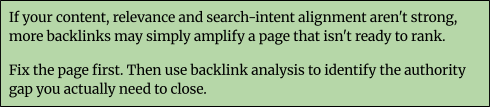
That is the difference between building backlinks for website ranking and building links simply because an SEO checklist says you should.
To Conclude With…
So how many backlinks does my website need? No, it is not about numbers. It is to build enough relevant, high-quality referring domains to close the competitive gap for the pages and queries that matter to your business.
Start with the SERP. Measure comparable pages. Remove outliers. Analyse the sources behind their links. Find the domains you don’t have. Then earn the right links rather than chasing the largest number. Because winning SEO isn’t about having more backlinks than everyone else.
It’s about having a stronger authority profile than the pages you need to beat and building an external footprint that helps your brand get found, trusted and referenced wherever your audience searches.
FAQs
Frequently asked questions
Explore the most frequently asked questions to better understand how our AI optimization solutions work and how they benefit your business.
How many backlinks do I need to rank on page 1?
There is no universal number. Use the top-ranking pages for your target keyword to estimate a realistic referring-domain benchmark, then adjust it for relevance and link quality.
Is 100 backlinks enough to rank?
It can be enough for one query and completely insufficient for another. Raw backlink totals are not a reliable standalone ranking target. Google’s systems use many signals, while independent studies show that link quantity alone does not explain ranking performance.
Do more referring domains always mean higher rankings?
No. Referring domains are useful for competitive benchmarking, but relevance, quality, content, intent and many other signals also matter. Google’s ranking systems are not a simple link-counting formula.
Can a website rank without backlinks?
Yes. Some pages can rank with few or even no external links, particularly when competition is weak, or the page strongly satisfies a specific query. Ahrefs has documented examples and also notes that correlation studies do not establish causation.
How often should I monitor backlinks?
Monthly is a sensible baseline for most sites, with more frequent review during migrations, major campaigns, aggressive link acquisition, or unexpected traffic changes.