
These days, when we want a quick recommendation, many of us just ask AI. “Which restaurant should I try?” “What software should I use?” “Which agency is worth hiring?”
Now imagine a customer asking AI for the best options in your category. Would your brand get a mention? Because showing up in those conversations is becoming just as important as knowing where a website sits in Google.
AI is becoming part of how people research, compare, and choose brands online. Instead of scanning ten blue links, users receive more synthesized answers that mention selected companies and cite a smaller set of sources.
That raises a doubt. Are backlinks still the strongest off-page signal, or are unlinked brand mentions becoming more important for AI visibility?
Research says brand mentions have a stronger observed relationship with AI visibility than raw backlink volume. But that does not make backlinks obsolete. The real opportunity is to build an ecosystem where mentions, links, authority and useful content reinforce one another.
Brand Mentions And Backlinks Are Not The Same Thing
A brand mention is simply when your company, product, or brand gets talked about online, whether or not someone links back to your website.
A backlink is different. It’s a clickable link from another website that points people to your site. The two can overlap. A publisher might mention “GEOized” and link to geoized.com. But they can also exist independently.
That distinction matters because AI systems do not simply reproduce Google’s backlink graph. Generative search systems synthesize information from websites, publishers, communities, reviews, videos, and other sources to construct an answer.
Princeton researchers introduced Generative Engine Optimization (GEO) as a framework for improving content visibility in generative engine responses. In their experimental evaluation, they found that GEO techniques could increase visibility by up to 40%.
The simplest way to think about it
Backlink: “This website points to me.”
Brand mention: “This website talks about me.”
AI citation: “This AI answer used this source.”
AI mention: “This AI answer actually names me.”
They’re connected, but each tells us something different about a brand.
What Does AI Visibility Data Prefer? Brand Mentions vs. Backlinks
Ahrefs’ analysis of 75,000 brands looks beyond Google AI Overviews and compares brand visibility across ChatGPT, Google AI Mode, and other platforms. The results suggest that AI visibility is influenced more by how widely a brand is discussed than by the sheer volume of links pointing to its website.
| Signal | Relationship with AI visibility |
| YouTube mentions | ~0.737 |
| Branded web mentions | 0.656-0.709 |
| Branded anchors | 0.511-0.628 |
| Branded search volume | 0.352-0.466 |
| Domain Rating | ~0.266-0.326 |
| Number of site pages | ~0.194 |
The standout finding is YouTube mentions, which showed the strongest correlation with AI visibility at approximately 0.737, ahead of branded web mentions. Ahrefs defines YouTube mentions as brand references appearing in video titles, transcripts, or descriptions.
Branded web mentions still performed strongly, with correlations ranging from 0.656 in ChatGPT to 0.709 in Google AI Mode. Ahrefs also found that branded anchors and branded search volume had meaningful relationships with visibility, although weaker than broader brand mentions.
The interesting part for SEO teams is what happened to traditional link metrics. That doesn’t make backlinks less valuable. Quality links from relevant, authoritative sources still play an important role in building website authority, increasing discoverability, and supporting overall search visibility (we’ll explain how in the next section). The key is to look beyond backlink volume and focus on the quality, relevance, and context of the links you earn.
There is another useful clue here. Google AI Mode showed the strongest relationship with established brand signals, including branded web mentions (0.709), branded anchors (0.628), and branded search volume (0.466). ChatGPT showed weaker relationships with traditional authority measures. This also suggests that not every AI platform evaluates brands in quite the same way.
But there is an important caveat. Correlation is not causation. Improving any one of these metrics will not automatically increase AI visibility. A brand that gets talked about frequently may also have stronger PR, higher search demand, better content, more customers, and greater overall authority.
Backlinks Are Dead: Myth or Reality?
It is indeed a myth. Backlinks still matter. But they are not the only parameters that brands should judge by volume alone. Google says its existing SEO fundamentals remain relevant to AI Overviews and AI Mode. AI-generated answers can still direct users to relevant websites through links.
So, should brands stop link building? No, but stop treating backlink quantity as the definition of authority.
A relevant editorial link from a respected industry publication can do more than strengthen your backlink profile. It can build authority, improve discoverability, reinforce what your brand is known for, and place your brand in a credible context that AI systems can potentially find and use.
A low-quality link built only to increase your backlink count provides far less value. For brands competing in crowded categories, relevance and credibility matter more than simply chasing bigger numbers.
The Biggest Misconception: An AI Citation Does Not Necessarily Mean an AI Mention
This may be one of the most important distinctions in modern AI visibility. Semrush’s recent “Ghost Citations” study analyzed 3,981 domain appearances across 115 prompts, 14 countries, and four AI search environments. It found:
| AI appearance | Share |
| Citation only, no brand mention | 61.7% |
| Both citation + brand mention | 13.2% |
| Brand mention without citation | 25.1% |
In other words, an AI system can use your page as evidence while never actually naming your company in the answer.
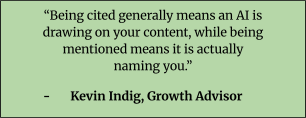
That distinction changes how brands should measure GEO. A citation is valuable. But if your commercial objective is brand discovery, an explicit mention can be much more meaningful.
So What Actually Creates AI Visibility?
Think of AI visibility as a network rather than a single ranking factor.
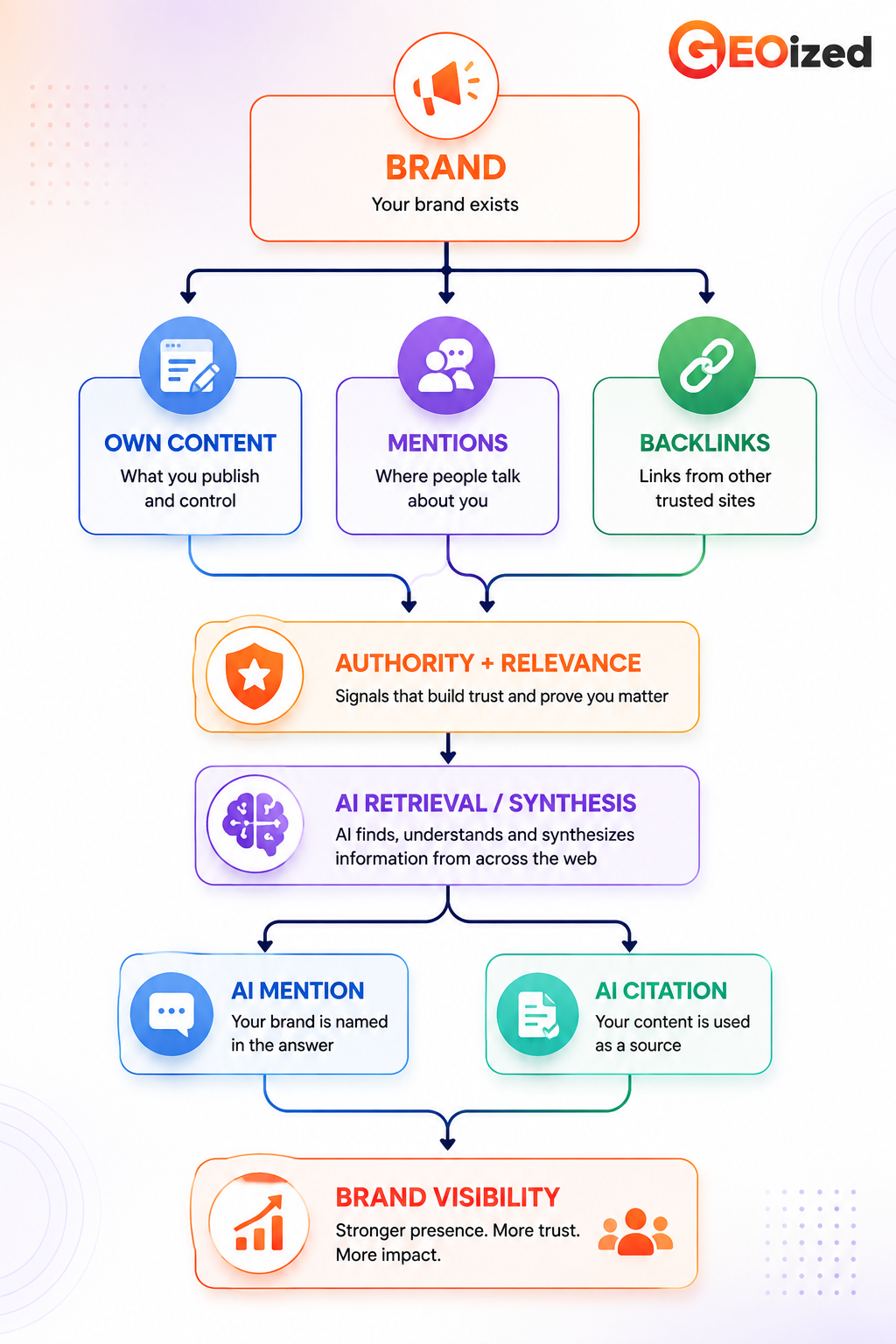
This is why chasing one metric can be misleading. AI systems need enough information to understand what your brand is, what it does, who it serves, and why it is relevant to a particular query. That information can come from your website. But it can also come from:
- Industry publications
- Reviews and comparison sites
- Reddit and Quora
- YouTube
- News coverage
- Partner websites
- Directories and reference sources
- Expert commentary
- Customer-generated content
Search Engine Land suggests that there is no single source that determines a brand’s visibility in AI search. Citation patterns vary by platform, search intent, and industry, with AI systems drawing from a broad mix of publishers, community platforms, and other third-party sources.
Consistency Is The Most Overlooked Factor
Here’s where many GEO strategies stop too early. Getting mentioned is not enough. Getting mentioned consistently and accurately is the real objective. Imagine your website says:
“Brand X is an enterprise cybersecurity platform.”
But industry publications describe it as:
“a small-business security tool.”
Reddit users, on the other hand, call it:
“an endpoint monitoring product.”
An AI system now has multiple descriptions to reconcile. This is why GEO should include entity consistency alongside traditional SEO. Your brand should have a recognisable semantic footprint across relevant sources:
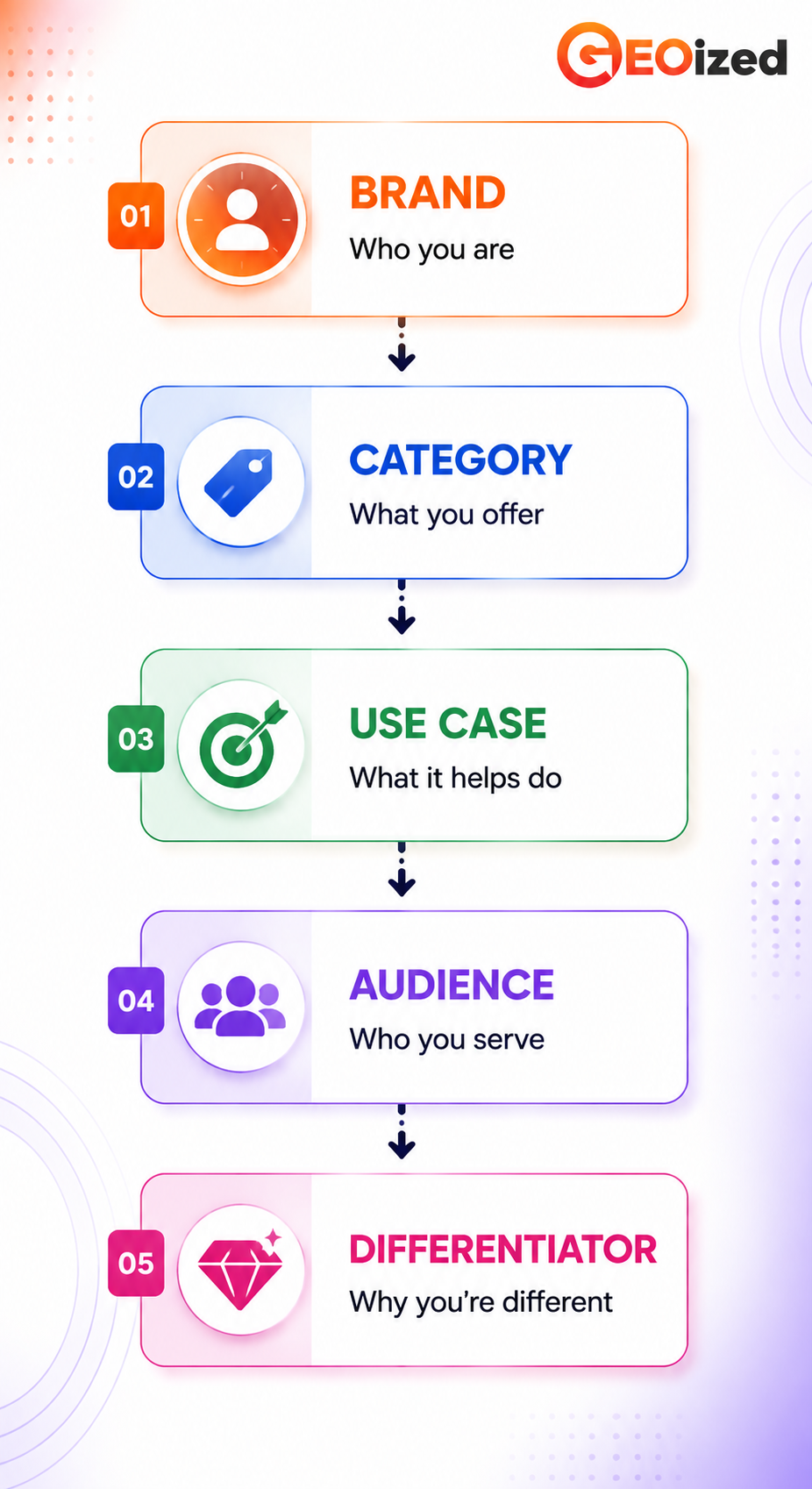
The more consistently those relationships appear in credible contexts, the easier it becomes for AI systems to associate your brand with the queries you want to win.
What Should Brands Prioritize: Mentions Or Backlinks?
Don’t choose one. Prioritize them differently.
| Objective | Priority | Why |
| AI brand discovery | Brand mentions | Stronger observed relationship with AI visibility |
| Traditional SEO | Quality backlinks | Still supports authority and rankings |
| AI citations | Citable content | Gives AI systems reliable sources to reference |
| Brand authority | Relevant third-party coverage | Builds independent validation |
| Competitive GEO | Mention + citation tracking | Shows where competitors are winning |
| Long-term visibility | Integrated strategy | Signals reinforce each other |
The strategy is therefore:
1. Earn relevant mentions
Get your brand discussed in places that genuinely influence your category.
Think expert roundups, industry publications, comparisons, reviews, communities, and editorial coverage rather than generic mention farms.
2. Build fewer, better links
Prioritize authoritative, contextually relevant publications over volume.
3. Make your own content easy to cite
Lead with clear answers. Define concepts. Add useful evidence and expert perspectives. Structure pages around the questions people actually ask. A study of generative search found that AI search systems strongly favored authoritative third-party sources and recommended making content easier for AI systems to scan, understand, and use as justification.
4. Track what AI actually says
This is the step traditional SEO dashboards cannot answer. Are you being mentioned? Which competitors appear alongside you? Which websites are being cited instead? Is AI describing your product accurately? Which prompts consistently exclude your brand? That is where AI visibility tracking becomes useful.
Grab Your Free $150 Backlink
How GEOized Can Help You?
At GEOized, we don’t see AI visibility as a replacement for traditional SEO. We see them working together. Our approach combines high-authority link building, digital PR, brand mentions, and on-page optimization to help businesses strengthen their presence across both traditional search and AI-powered search.
GEOized adds the measurement layer. You can monitor where your brand appears in AI answers, how often you’re mentioned or cited, which competitors are showing up instead, and which sources are influencing those results.
That means you can build the right authority across the web, optimize your own content, and see whether those efforts are translating into greater visibility across Google and AI search platforms.
Build authority. Improve visibility. Measure what works best.
To Conclude with…
Brand mentions are not replacing backlinks. It’s that AI search is adding another layer to how brands build and measure their online authority. The winning strategy is not to abandon backlinks. It is to stop viewing them as separate entities.
Backlinks build authority, mentions build recognition, and citable content builds evidence. AI visibility tracking tells you whether the combination is actually working. The brands that win in generative search will not necessarily be the ones with the biggest backlink profile or innumerable mentions.
They will be the brands that AI systems can find, understand, validate, and confidently mention.